Every Picture Tells A Song: Inside Jay Blakesberg & Steve Poltz’s Grateful Dead Collaboration
The veteran concert photographer and singer-songwriter discussed how the project came together … and what’s next.
By Andy Kahn Oct 13, 2026 • 9:50 am PDT

Song Summit 2026/Photo by Amy Harris
At Song Summit in Park City, Utah, I watched photographer Jay Blakesberg take a Summit Lab audience through his career in Grateful Dead photographs while singer-songwriter Steve Poltz answered his stories with songs made up on the spot.
Summarizing what was billed as “Workingman’s Dead: Songs, Stories and Improvisation Inspired by the Music of Bobby Weir of the Grateful Dead,” I wrote in my Song Summit recap:
Jay Blakesberg, who began taking photos of Grateful Dead concerts in the 1970s and later shot portraits of the band, held a visually-driven Summit Lab presentation co-hosted by singer-songwriter Steve Poltz.
Blakesberg led a journey through his life in photos, explaining with humility and humor his path from Deadhead to becoming one of the primary photographers to work with the Dead. Blakesberg shared personal photos leading into his first shots of the Grateful Dead, through his career capturing the band (and others) and up to his current work. Grateful Dead members Jerry Garcia, Bob Weir and Phil Lesh were the focus of extended sequences within the photo show.
Poltz at times interjected with seemingly on-the-point and on-the-spot impromptu songs referencing Blakesberg’s sensational stories. Other musicians also joined Poltz for musical interludes, including Eric Krasno, Ross James, Nicki Bluhm, Mikaela Davis, John Shannon and Holly Bowling. My Morning Jacket frontman Jim James also came out for the poignant “Ripple” finale.
Blakesberg is as good behind the lens as he is behind a microphone, and his Summit Lab was outstanding. If given the opportunity to see him present it elsewhere, I highly recommend doing so.

Song Summit 2026/Photo by Maeve Reiss
After connecting with Blakesberg at Song Summit we followed up to dig deeper into what he and Poltz crafted for the event. Both Blakesberg and Poltz shared insights into how their collaboration developed, their approach to presenting the music-backed slideshows, and perhaps most importantly, the possibility of them taking their show on the road.
From A Rolling Wall To A Festival Stage
The idea began about three or four years ago at a small festival called Golden Road, Blakesberg told me. He had been asked for a 45-minute Grateful Dead slideshow for roughly 75 people, and Poltz was there teaching songwriting workshops. Blakesberg proposed a bit modeled on Jonathan Richman’s commentary-from-a-tree scenes in There’s Something About Mary.
“Let’s do that at this thing and we’ll surprise everybody,” Blakesberg said he told Poltz. After Blakesberg’s first story, Poltz walked out from behind a rolling room divider and made up a song about it.
Two years ago at Song Summit, Blakesberg had a 50-minute slot and kept Poltz in the dark. “[Poltz] had no idea what I was going to do, what I was going to talk about, what stories I was going to tell,” Blakesberg said. Afterward, they looked at each other and said, “Let’s do this again and go on the road and get in a Winnebago and tour the country.” Schedules got in the way.
Blakesberg meanwhile built a separate Allman Brothers and Grateful Dead storytelling concept, with scripted videos made by his son Sam and a date held at a New York venue for January 2027.Sam told Jay the videos and concept were not working “These are just terrible,” his son Sam told him, Blakesberg said. “I agree,” he replied, and canceled the date.
That left Poltz, whom Blakesberg first saw sing “Box of Rain” about 10 years ago at late Grateful Dead bassist Phil Lesh's now-defunct Terrapin Crossroads venue in San Rafael, California.
“He owned that song,” Blakesberg declared. “He owned his rendition of that. And it was moving and it was touching.”

Jay Blakesberg photographed with Phil Lesh’s legendary "Big Brown" bass guitar at Terrapin Crossroads - May 4, 2015
The two booked a July 15 show at Garcia’s in Chicago and took the format to High Sierra Music Festival in Grass Valley, California first, where it was listed as a Grateful Dead-themed multimedia Playshop in a preview of the festival’s Playshops. Blakesberg said that “we thought 10 people were going to come and a thousand people came.”
833 Slides In 75 Minutes
In Park City, extended sequences focused on Jerry Garcia, Weir and Lesh. Blakesberg told me he organizes the visuals around individual band members. Garcia photographs from the 1960s onward were accompanied by “Uncle John’s Band,” photos of Weir ran during “Cassidy” and photos of Lesh projected during “Box of Rain.” “Attics of My Life” gets about 300 images spanning the Grateful Dead and its offshoots. The “Ripple” slideshow portion is made up of images of Deadheads.
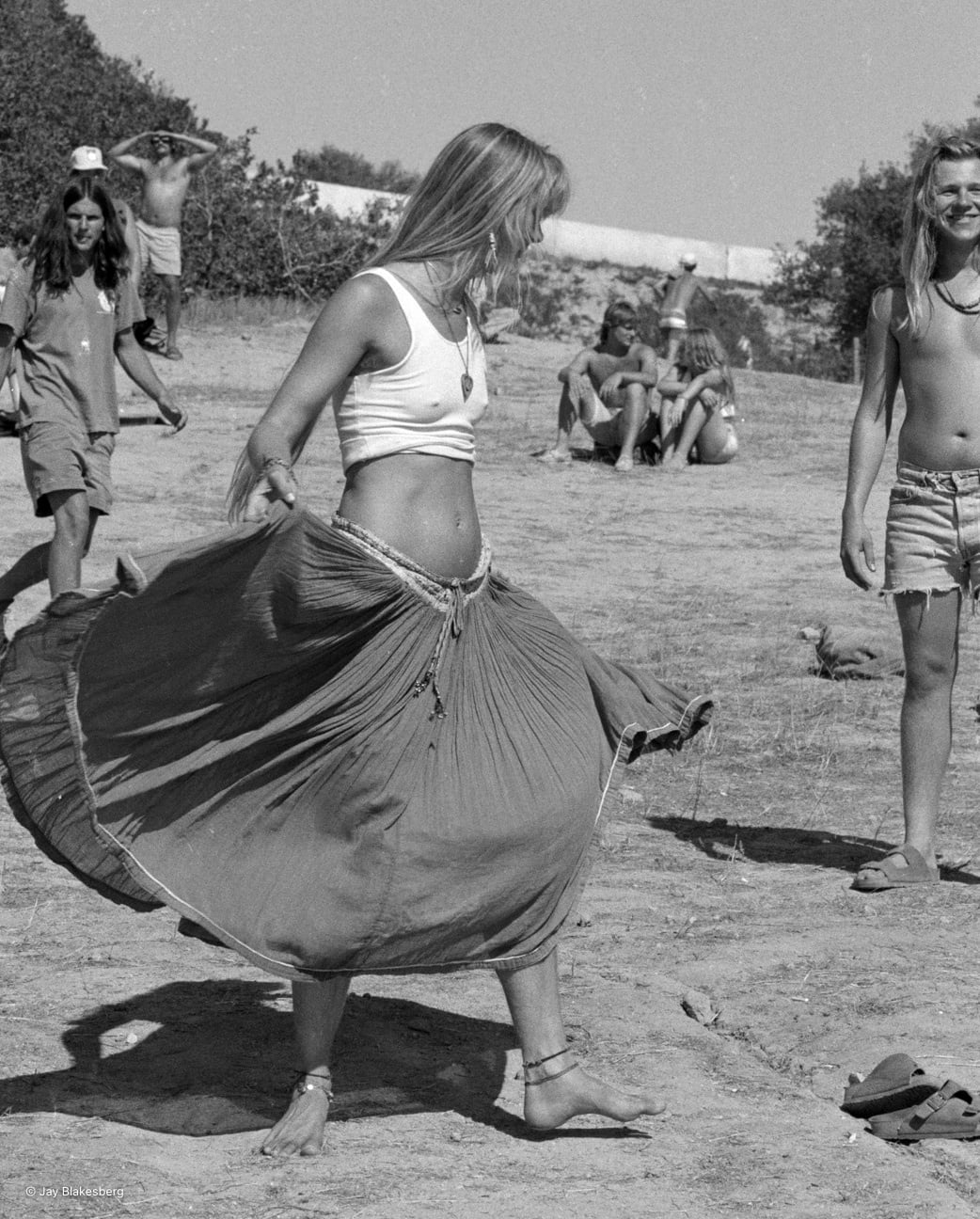
Photo by Jay Blakesberg
“I could be shooting a picture of the band on stage or what’s going on in the audience and what’s happening in the audience is just as magical,” Blakesberg said of why he photographed the group’s loyal fans.
He said the Song Summit lab used 833 slides across 75 minutes and those five songs. If Poltz finished early, he stayed silent while the slides ran out, and if the slides ended first, Blakesberg left the last image up and the song continued.
Many of the images come from Retro Photo Archive, which Blakesberg runs with his daughter, Ricki Blakesberg. The archive manages about 30 collections, including work by Kirk West, Ron Rakow, Snooky Flowers and Rosie McGee. He has more material than he has used.

Photo by Ron Rakow/Retro Photo Archive
“I have an entire slideshow that’s made up of Grateful Dead ticket stubs,” he said, along with backstage passes, laminates and an in memoriam sequence for band members, family and crew. “We haven’t even gotten to that one yet.”
When I asked him to sum up the format, Blakesberg called it “an improv comedy, Grateful Dead, multimedia, legacy” project. “It’s never the same twice,” he added.
How Poltz Came To The Dead
Poltz, who started in punk bands and later co-wrote Jewel’s smash hit “You Were Meant for Me,” knew the Grateful Dead for decades without being a Deadhead. That changed about 14 years ago, when he had a stroke in Wilmington, Delaware.
“It was almost like somebody hit me in the head with a 2×4,” he said. Back in San Diego, a driver taking him to the airport played “Ripple,” and “I started crying.”
“I like to tell people it took a stroke to get me into the Dead,” he said. “After the stroke, all I wanted to do was listen to the Dead. It seriously really started making sense to me.”
His punk fans, he said, were not pleased. Blakesberg became what Poltz called his “north star” for the music’s history.

Steve Poltz photographed at High Sierra Music Festival in Quincy, CA July 3, 2016 ©Jay Blakesberg
Blakesberg estimated that Poltz learned “Wharf Rat” about eight months ago, and Poltz said he did it while driving home from Oregon shows. He debuted it solo at Sweetwater Music Hall in Mill Valley, California, and went into the crowd.
“Solo acoustic sometimes you can almost have more power than a full band at certain times by going right into the audience and making everybody turn into this community,” he said.
At the Marquis in Park City, Poltz repeated the move and Sierra Hull joined him for a memorable collaboration and crowd-interaction.
“Attics of My Life” was harder. Poltz said he struggled with its harmonies while touring Cape Breton, Nova Scotia, until he found a solo Garcia demo from a box set.
“This is how I do it solo … Jerry’s my teacher,” he explained.
How Poltz Writes On The Spot
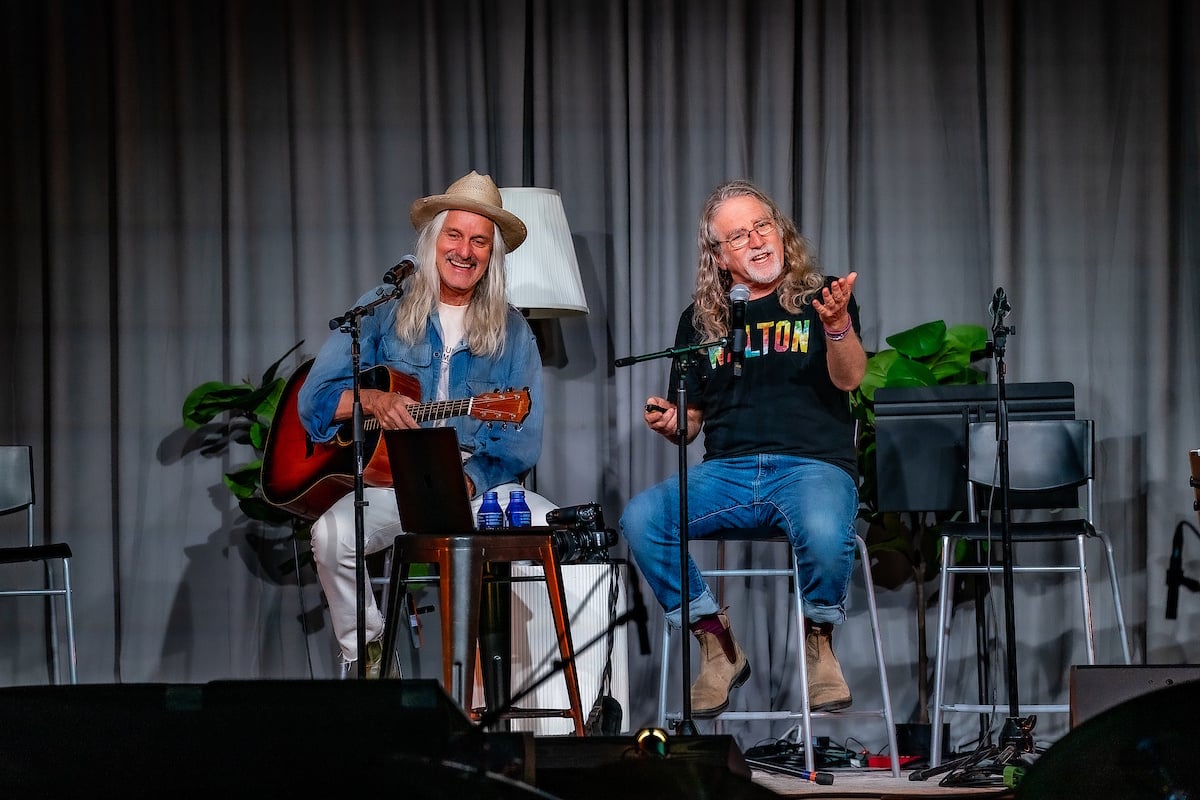
In Park City, Poltz worked impromptu songs into Blakesberg’s stories. When asked whether making them up on the spot feels like walking a tightrope, the veteran singer-songwriter said it comes easily.
“I love making up songs on the spot,” he said. “I started doing it when I was 6 years old for my dog. I have a weird superpower for taking something somebody says and turning it into a song and making it hook-y.”
Song Summit 2026/Photo by Amy Harris
While Blakesberg talks, Poltz goes quiet. The guitarist described what happens next:
“When Jay’s talking about something, I’m just almost in a zen state. And if you were to watch me, my eyes might be kind of shut and I’m rocking back and forth like this.”
“I have no clue what the key is. All I know is I’m gonna spit out something and it’s going to slowly formulate. It’s going to be a zygote and it’s going to turn into this fully formed kind of not fully formed song, but an idea of a song and I know that it’s going to happen. It’s almost like I’m jumping out of a plane and I know I’m going to land on my feet.”
Blakesberg said the finished song usually follows the end of a story. “When he actually sings the song and makes up the song, it’s about the thing that I said at the very end,” he said.
At High Sierra, Poltz led a crowd sing-along about a story from Blakesberg’s youth involving trading his meat for vegetables. When Blakesberg told the story again later, Poltz wrote a different song that never mentioned meat.
Picking Up Hitchhikers
Poltz calls the guest musicians hitchhikers. “What we’re doing is we’re picking up hitchhikers along the way,” he said. “So each time it’s like a different spaghetti sauce that we’re making, but the basics is we’re using San Marzano tomatoes and some garlic and we’re stirring it around, but it comes out different.”
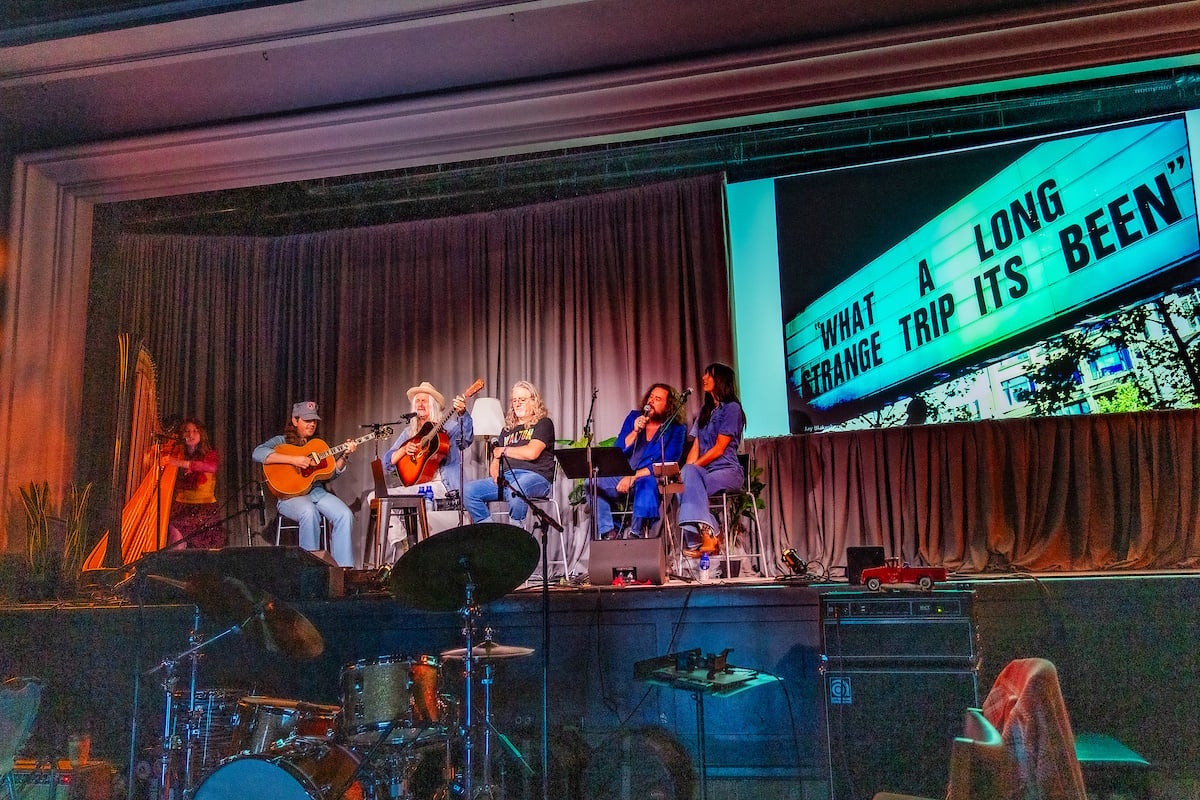
In Park City, the hitchhikers were Nicki Bluhm, Ross James, Eric Krasno, Holly Bowling, Mikaela Davis and John Lee Shannon. Blakesberg called Bluhm, James and Krasno in advance and texted Bowling, who was already at the festival.
“What do you mean sit in? Like, what does that even mean?” he recalled Bowling asking how the photography collab would work. Davis and Shannon had a similar question. “You take photos of us,” he recalled them saying. Davis was first asked to play one song. “I think you need to play on everything,” Blakesberg said they decided 15 minutes before showtime.
Jim James came out for the “Ripple” finale, which was particularly poignant.
“We had the greatest band ever doing this thing with us,” Blakesberg said. Poltz was just as open to the guests. “I love the collabs. Whoever Jay suggests, I’m like, let’s do it,” he said.
Song Summit 2026/Photo by Amy Harris
The mix was different at High Sierra, where Lebo and Jake Brownstein of Eggy sat in. Blakesberg said each came into the dressing room 10 minutes before the show and asked, “What are we doing?”
Midway through, Blakesberg switched to a story about Robert Plant photographing a gopher eating a picture of Garcia at Hardly Strictly Bluegrass. He looked at Poltz and said “Stairway.” Then he turned to Brownstein. “You know the solo for Stairway, don’t you? Because you got to do it,” Blakesberg said he told him. Poltz sang Led Zeppelin’s “Stairway to Heaven” with the lyrics to the Gilligan’s Island theme, and Brownstein played the solo.
Lebo then joined the Chicago show. During “Attics of My Life,” he started a solo from the back of the room on a wireless guitar (ala Richman’s Something About Mary approach), walked through the audience and climbed onto the stage beside Blakesberg while final portraits of Lesh and Weir were on screen.
“Everybody’s just weeping again,” Blakesberg recalled.
At Chicago, Blakesberg also surprised Poltz with photos of the Replacements, whom Poltz had named as his favorite band at High Sierra, and Lebo learned a lick. Poltz picked up on it and played part of “Can’t Hardly Wait.”
Carrying The Songbook Forward
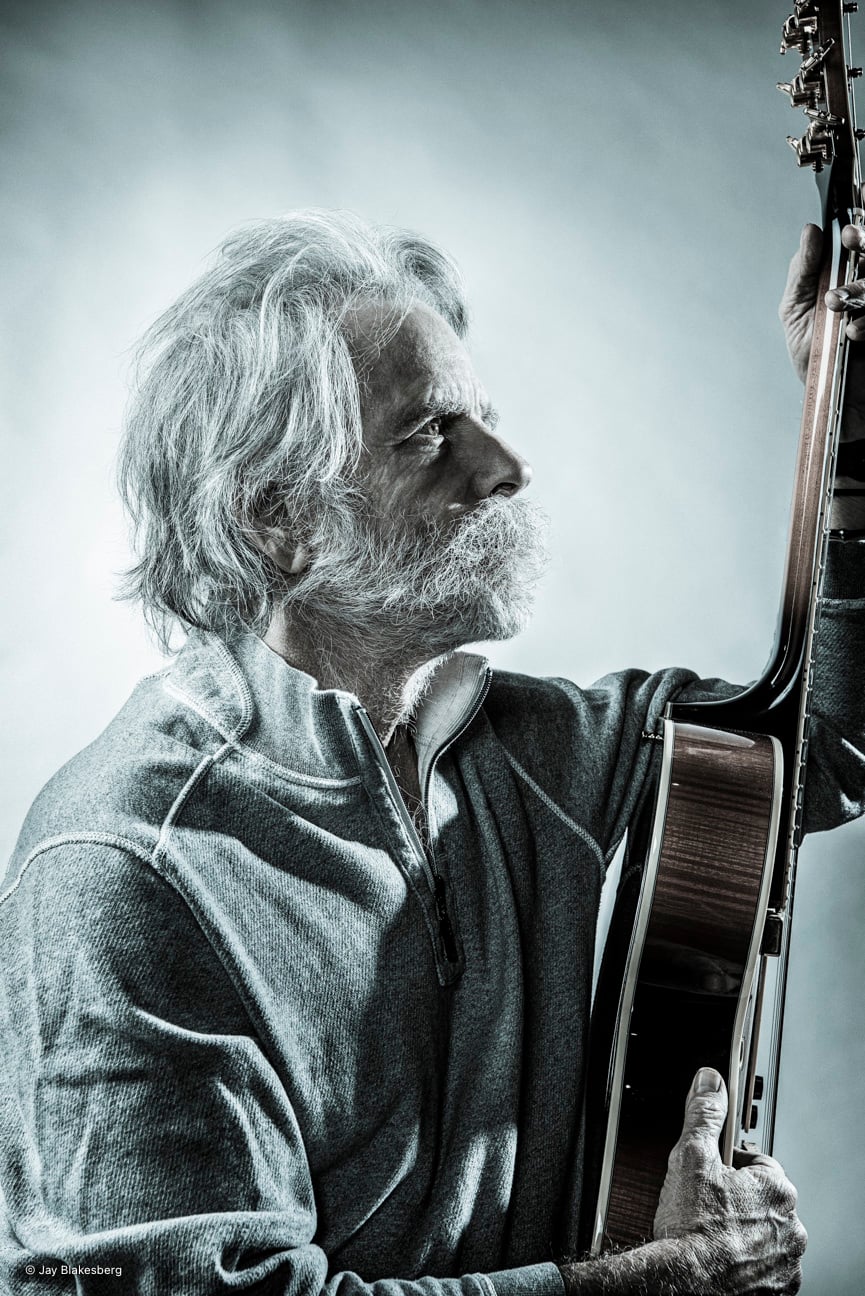
Blakesberg said his first portrait of Weir was in 1979, when he was 17, and that Weir hired him in 1990 to photograph him and Rob Wasserman. At his last session with Weir, in 2023 in Marin County, Weir asked, “Jay, don’t you have enough photos of me?” Blakesberg replied, “Haven’t you played ‘Me And My Uncle’ enough?” They both laughed. Weir died in January. Lesh died in 2024.
When asked how the project fits among the Grateful Dead’s legacy, Blakesberg named Joe Russo’s Almost Dead and Dark Star Orchestra as acts with their own original takes.

Photo by Jay Blakesberg
“We’re not trying to be a band. We’re trying to be an artist with collabs musically.” He added, “I bring this storytelling visual side to it that nobody else is really doing or has done yet.” He described the mission as keeping the music going in the era after Weir and Lesh “for the next 300 years.”
Poltz said of the music, “It really is the great American songbook.” He said the project suits him because “I like to bring joy to people.” “And we’re joy missiles,” he added.
Blakesberg and Poltz have talked about potentially booking spring dates to take the musical slideshow on a tour of some sort. Blakesberg said he hopes to book a San Francisco one-off.
“My fantasy of this is that we do this three or four times a year with little three or four show runs,” he said, in regional clusters such as Cincinnati, Pittsburgh and Chicago or stops across Oregon and Washington. He also wants to invite guitarists from Grateful Dead cover bands in places such as Dallas; Tampa, Florida; and Charleston, South Carolina. “We will pay you, but we want you to bring what you bring to it because you are part of this song book,” he said.
Bob Weir photographed in Marin County, CA February 3, 2016 ©Jay Blakesberg
Poltz said he could add it to his regular tour. “I could see this doing a run in a little theater like, you know, the Walter Kerr Theater in New York,” he said. His next scheduled shows include the November 11 start of his Midwest tour at The Parkway Theater in Minneapolis. Blakesberg also curated photography for the exhibition Forever Grateful/Golden Gate Park at the County Fair Building in San Francisco, which runs through October 25.
Blakesberg and Poltz are still figuring out where to take the show next. Wherever they land, the photographs will preserve moments from the Dead’s history while Poltz makes up something new.
Loading tour dates
