Joe Marcinek Talks Building The Dead Funk Summit, Musical Collaboration & The Art Of The Unexpected
The road-tested guitarist breaks down his improvisational ethos, all-star sit-ins and the ongoing evolution of his project.
By Andrew Wetzler Jul 6, 2026 • 1:31 pm PDT
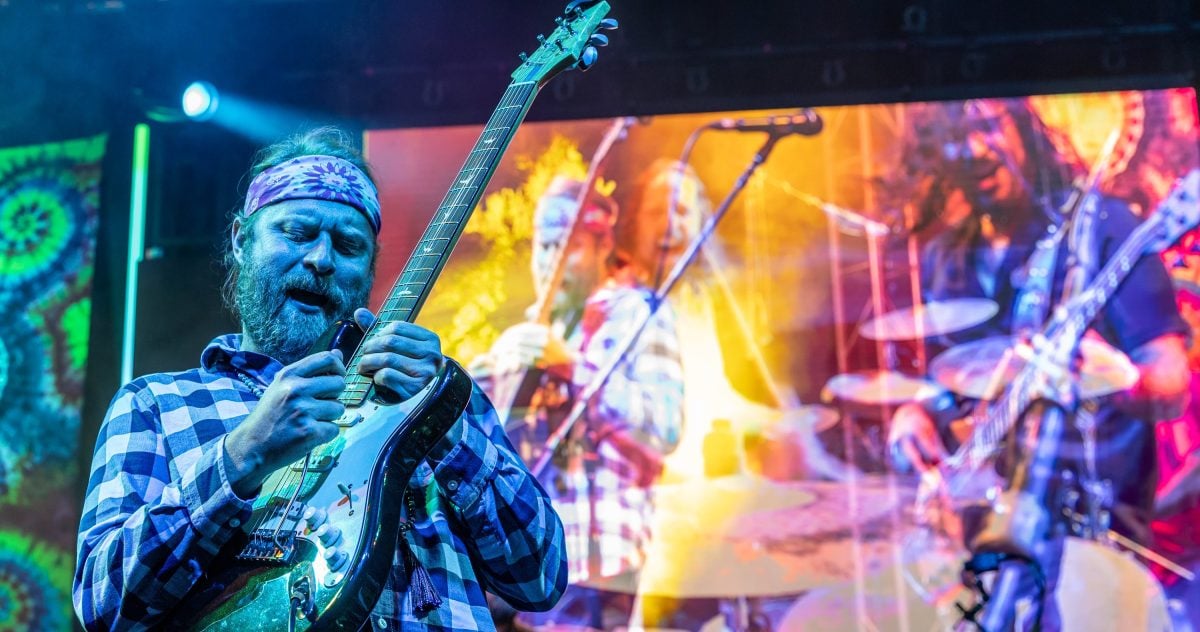
Joe Marcinek has created an impressive following over the past 18 years with his inventive approach to both music and touring. The guitarist regularly records and shares the stage with some of the most influential members of the jam, Dead and funk communities.
I caught up with Marcinek after his recent show at the Funky Biscuit in Boca Raton; part of a weekend of shows he performed with an all-star group of musicians in South Florida.
JamBase: Your approach reminds me a little of Chuck Berry — showing up in town, assembling local musicians, and putting on a great show. You’ve taken that concept in a very different direction. How did you evolve from a traditional touring band into the collaborative model you’re known for today?
Joe Marcinek: Honestly, it wasn’t something I consciously set out to create. When I finished college in 2008, I joined a regional band in Northwest Indiana called Fresh Hops. We were writing original music and touring throughout the Midwest.
Around that time, a drummer friend from high school returned home after attending Berklee College of Music. We decided to play a few shows together just for fun. Since I was already performing locally, I promoted it under my own name, and that’s how the Joe Marcinek Band started.
There was never a grand plan. It was simply a side project that became more exciting as it grew.
One of the realities was that many of the musicians I wanted to work with were already playing in multiple bands. I’d have one incredible bassist one night, another keyboard player the next, and different guest musicians every weekend. Rather than seeing that as a limitation, it became part of the identity of the project.
Every show felt different, and that kept it exciting for both the audience and me.
As my touring expanded beyond Northwest Indiana into Chicago, then Wisconsin, Michigan, Indianapolis, and beyond, my network of musicians naturally grew. Every new city introduced me to more great players, and that collaborative circle kept getting larger.
JamBase: Was there an artistic influence behind that philosophy?
Joe Marcinek: Absolutely. I came of age during what I consider the peak of the jamband era. One of the biggest influences was attending the very first Bonnaroo in 2002.
Looking back, nearly every artist I watched invited someone onstage to sit in. Those spontaneous collaborations became some of the most memorable moments of every performance.
I didn’t fully realize it then, but that experience planted the seed for what I do now.
Another huge inspiration has been the Everyone Orchestra. Their constantly changing lineup and emphasis on improvisation really resonated with me.
The difference is that I also wanted to write original music. So I essentially combined those two ideas: constantly rotating musicians performing original compositions that evolve every night.
That’s what makes it exciting.
The same song can sound completely different depending on who’s playing. One night it’s funkier. Another night it’s jazzier. It might be slower, faster, more improvisational — it all depends on the chemistry in the room.
JamBase: How do you decide what songs make the setlist when the personnel changes so often?
Joe Marcinek: The musicians themselves help shape the show. When someone like Tony Hall from Dumpstaphunk is playing, there are certain songs he naturally gravitates toward. Maybe it’s a Meters tune or something he enjoys singing.
Generally, I build every performance around three elements: my original music, songs that highlight the guest artists, and covers everyone enjoys playing.
Lately that often includes Grateful Dead material.
That balance gives everyone ownership of the performance while keeping it fresh.
Since rehearsal time is usually limited, I’ll send music ahead of time, work through any complicated parts during soundcheck, and then let the magic happen onstage.
JamBase: That seems like it requires a tremendous amount of trust between musicians.
Joe Marcinek: It really does.
I always compare it to basketball.
You can take great players from different teams and put them together. They may not know every play, but they understand the game.
Improvised music works the same way.
Everyone knows the key, the chord changes, and the structure. The real excitement comes from reacting in real time to what someone else plays.
Sometimes mistakes become the best moments of the entire show.
If someone accidentally hits an unexpected chord, everyone else follows them, and suddenly you’re somewhere you never intended to go musically.
Those unplanned moments are impossible to recreate.
That’s the magic I love most.
JamBase: You’ve collaborated with an impressive list of musicians over the years. Which experiences stand out?
Joe Marcinek: Very early on I worked with Steve Molitz from Particle, who had a big influence on me.
Then I was fortunate enough to collaborate with Bernie Worrell before he passed away, which was incredibly meaningful.
Working with Tony Hall eventually led to playing with George Porter Jr., someone I’d dreamed of performing with for years.
Another major milestone was collaborating with Melvin Seals from the Jerry Garcia Band.
One musician who left an especially deep impression on me was Sean Martin of Snarky Puppy. He was probably my favorite musician I’ve ever shared a stage with—not only because of his talent, but because he was such a kind and beautiful human being.
Those collaborations have all shaped me in different ways.
JamBase: How did the Dead Funk Summit come together?
Joe Marcinek: The idea started after I began playing with George Porter Jr. and Melvin Seals.
I kept thinking, “What if I could get both of these legends onstage together?”
George represents the pinnacle of New Orleans funk through The Meters.
Melvin represents the Grateful Dead universe.
Bringing those two musical worlds together became the inspiration for the name Dead Funk Summit.
The first performance happened in 2018 at the Fox Theatre in Boulder, Colorado.
I actually positioned myself onstage where I could see both George and Melvin at the same time. I can still picture that moment. It was incredibly powerful.
During the pandemic, while live music was on pause, I started writing new material and wondered what it would sound like if both of them played on an album of my original compositions.
That became the Dead Funk Summit album.
It wasn’t about recreating Grateful Dead songs or Meters songs, it was about creating entirely new music with those legendary musicians.
That was a dream come true.
JamBase: How did the live Dead Funk Summit shows evolve from there?
Joe Marcinek: After the pandemic, everyone was eager to get back to performing.
I wanted a way to brand these larger collaborative shows as something beyond a standard Joe Marcinek Band performance.
The first major version was built around Dead & Company after-parties in Chicago.
We brought together around fifteen musicians each night, including Robert Randolph, Robert Walter, and an incredible lineup of guests.
Calling it the Dead Funk Summit perfectly described what audiences were getting:
Grateful Dead music.
Classic funk.
My original compositions.
Everything I love wrapped into one event.
Today, we stage these shows selectively throughout the year, during Jazz Fest in New Orleans, special after-parties, festivals, and major destination performances.
They’re designed to be special occasions rather than something that happens every weekend.
JamBase: What’s next for you?
Joe Marcinek: This spring I released my tenth album, which is still hard for me to believe.
I’m only 41, and somehow I’ve already made ten records.
The newest release is my first live album, recorded at the legendary Iridium Jazz Club in New York City.
The lineup included Dennis Chambers on drums, Howard Levy from Béla Fleck and the Flecktones, Jason Hann from The String Cheese Incident, Jesus Molina, and vocalist Reilly Comisar.
Although most of my previous records have been instrumental, I’m beginning to incorporate more vocals into my original music.
I enjoy singing occasionally, but I really love collaborating with great vocalists.
I’ve recently been working with drummer and singer Cliff Porter from Reno, Nevada, and we’re planning to release a new vocal-focused album next year.
That’s probably the next evolution of my music.
JamBase: You’re been on the road constantly. What’s your ideal touring schedule these days?
Joe Marcinek: Before the pandemic I played around 250 shows a year.
It was exciting, but honestly, it was probably too much.
This year I’ve already traveled through 24 states in just six months.
I’m not really on a traditional tour anymore.
Instead, I’m almost always traveling.
Because I don’t have one permanent band, it’s difficult to stay on the road for weeks at a time.
The ideal schedule is to spend three or four days in a region, play several shows with local musicians, return home briefly, then head to another part of the country.
Doing that a few times each month feels like the right balance.
Being based in Northwest Indiana also makes it easy to continue performing throughout Chicago and the Midwest while still making trips to places like California, Colorado, New York, and Florida.
Joe Marcinek’s next major Dead Funk Summit performance takes place July 23 at the Bearsville Theater in Woodstock, New York. Marcinek will be joined by The Disco Biscuits bassist Marc Brownstein, moe. drummer Vinnie Amico, Particle keyboardist Steve Molitz, veteran Reno drummer Cliff Porter, vocalist Steph Salva and more for an evening where funk, improvisation, Grateful Dead influences and original music collide.
Advertisement
Loading tour dates
