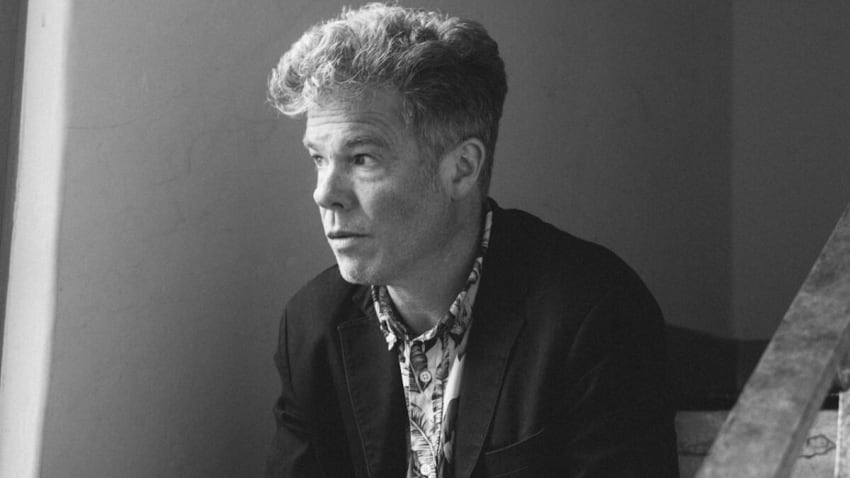
Josh Ritter's The Animal Years is the kind of breakthrough effort that
will cause listeners new to the 29 year-old singer-songwriter's work to wonder
where this guy has been all their lives - and prompt his passionate fan base to
just say, well, we told you so. Following the independent release of The Golden
Age of Radio (2002) and Hello Starling (2003), Ritter was championed
by critics in publications ranging from the New York Times to Details Magazine,
hailed by fellow artists who shared stages with him, and name-checked by anyone
who happened to catch him on tour during the years he doggedly worked the road.
The music-savvy citizens of the Republic of Ireland christened him a major star
well before anyone in the states even knew he had a record out. On The Animal
Years, his V2 Records debut, Ritter more than lives up to the buzz. He embraces
the topical while reaching for the timeless, resulting in an album that's firmly
rooted in right now but guaranteed to resonate for years to come.
Ritter doesn't reinvent himself on The Animal Years; he simply sets
aside traditional ideas of what a guitar-toting, folk-based troubadour should
do. Looking to select a producer, Ritter chose a smart but decidedly out-of-left-field
candidate: Brian Deck, a one-time member of Chicago indie rockers Red Red Meat,
best known now for his forward-thinking work with Modest Mouse on The Moon
and Antarctica and Iron and Wine on Our Endless Numbered Days.
"It was great working with Deck," Ritter says. "I was very lucky.
He was a guy, I felt, who was as weird as I was. There was stuff that I could
bring up, like wanting 'Monster Ballads' to sound like Mark Twain's Tom Sawyer,
and he didn't bat an eye. He was just into the idea. So it was great - he was
going to be my collaborator."
They went to Bear Creek, a big barn of a studio outside of Seattle, isolated
enough from the city to make an Idaho native like Ritter feel right at home.
According to Ritter, Deck viewed the studio "as another instrument and
the person playing that instrument was listening really hard to what was being
said and what was being played." On The Animal Years, the production
never calls attention to itself, even though all the tracks were artfully layered,
all the sounds carefully considered. It feels as if the songs are just being
breathed into life then and there, and they practically demand to be listened
to the old-fashioned way, start to finish, as an entire album. Ritter and Deck
incorporate subtle electronic elements that gurgle and bleep underneath the
conventional instrumentation on "Wolves" and they push piano and Hammond
Organ to the forefront of "Monster Ballads," accompanied by a shuffling,
brushed snare rhythm. On the haunting "Idaho," they just rely on a
hint of acoustic guitar, the hum of the room and Ritter's voice, which leaves
words behind to fade out on a note of lonesome falsetto. As he relates, "I
was in a huge barn late at night and I was playing the guitar as quietly as
I could. 'Idaho' was kind of like a mistake, not something I had planned to
record. We had been working on a song that was going nowhere and we were all
getting frustrated. We took a break and I recorded that off the cuff just so
I could feel like I had done something that day. It turned out so great and
so bizarre. The two mikes on the vocals were between phases, there were all
these things coming from the other mikes in the room that we had left on. I
tried to do it over, but I couldn¹t. "
Though Ritter places many of his story-songs in intimate settings, he's not
afraid to tackle big ideas and anthemic arrangements. The riveting opener "Girl
in the War" and the dramatic "Thin Blue Flame," perhaps the most
audacious track Ritter has ever recorded, recall the genre-busting rock of artists
like Bright Eyes and Wilco, but Ritter goes even further conceptually and emotionally.
These songs represent perhaps the most eloquent expression to date from any
pop artist of the physical, emotional and spiritual consequences of the Iraqi
war and the divided state of our nation. "Girl in the War" is as stark
and stirring as "Born In the U.S.A.," and much more immediate. Ritter
explores the deepening dread of the Middle East conflict, imagining his words
as an epistle to St. Paul: "I've got a girl in the war, Paul, her eyes
are like champagne/They sparkle, bubble over and in the morning all you've got
is rain."
On "Thin Blue Flame" Ritter steps out of the third person to face
his audience directly and articulate his vision of a world in which religious
calling becomes a battle cry and everything on earth is sacrificed in the name
of heaven. His words combine apocalyptic, gospel-like testifying with dreamy,
stream-of-consciousness poetry. As Ritter explains, "The word 'apocalypse'
means unveiling, you know, not just the end of the world. In some of the real
apocalyptic literature like The Divine Comedy or Paradise Lost, or even Gravity's
Rainbow or Slaughterhouse Five, a person goes through a long series of trials
and tribulations, seeing things and coming back with new knowledge and maybe
new warnings. In the past year, we didn't have to go anywhere to see those kinds
of things. We all have TV. We all can see what's going on and there's no one
who can say it's a good thing. 'Thin Blue Flame' is a trip through what everybody
can see. I was just writing down the images I saw as they came to me. I worked
on it for a long time, My notebook was filled with 'Thin Blue Flame' for a year
and a half."
Ritter is comfortable with literary and historical allusions, and is as much
in love with words as music, and that really shows in his lean, evocative narratives.
He envisions The Animal Years as "an escape from the present,"
a look back at an earlier time to make sense of what's happening now. He likens
the album to "a silent film -- a mysterious old movie reel unearthed somewhere
- about America today." For inspiration, Ritter went back to the work of
Mark Twain and the letters of Thomas Jefferson and John Adams -- writers deeply
concerned with the state of the union -- to study their own escapist impulses
at critical times in our nation's history.
Ritter came to music late in his teenage life, subsisting for many years on
his folks' meager record collection. It wasn't until the 18 year-old found a
copy of Bob Dylan's Nashville Skyline at a shop in his hometown of Moscow, Idaho
and heard the Dylan/Johnny Cash duet of "Girl From the North Country,"
that he was inspired to pick up a guitar. As he once told No Depression, "Hearing
that record the first time was like meeting that person you know you're going
to marry." When he moved east to attend Oberlin College in Athens, Ohio,
he thought he'd follow his parents into neuroscience, but soon switched to an
American Studies curriculum that he more or less devised for himself, with an
emphasis on the history of folk music. Once he'd finished college, he migrated
to Boston, determined to find a niche as a singer-songwriter.
"There were stories about John Prine, Tracy Chapman, Joan Baez, Bob Dylan,
Bruce Springsteen," he says. "All these people started playing at
these little coffee shops. I figured that was the way to do it. I was working
in Rhode Island at a typically awful temp job and doing open mikes in Boston,
three or four of them a week. About a year into that, I met the Frames, a great
Irish band, who were playing just down the street at T.T. the Bear's. They came
down to the open mike where I was performing to have a drink. They heard me
play one song and then they invited me to come over and open all their shows
when For The Birds came out. My first one was at Whelan's in Dublin, opening
for the Frames in front of 400 people. Oh man, it felt like everything was coming
to fruition and I was right. I could do it. People maybe would want to hear
this stuff. I sold 10 CDs that night and I felt like the richest man in the
world."
His success in Ireland soon built to substantially large audiences, but spreading
the word in the United States required even more hard work, and countless days
and nights on the road. His tenacity paid off as he built a loyal and ever-larger
cult following via word of mouth and some great reviews. The Animal Years
refers to the long, grueling time he spent touring behind Hello Starling,
a Herculean effort that ultimately yielded him the V2 deal and the chance to
kick back -- for a few weeks at least -- at the new house he bought in rural
Idaho.
"The title had been in my head for a while and I tried to convince myself
it wasn't the one I should use," Ritter admits, "but for me it was
perfect. I was thinking back on the period of my life leading up to this record
and my experience up to that point was, you get up, you start to play music
and you tour. It's such a strange life style. In a lot of ways I felt like I
became this thing, half-man, half-animal, out in the middle of the country,
playing. It was so bizarre. Everyone else is living their lives and doing things
that are bit more normal "Man, after a year and a half on the road, 16
months of touring for Hello Starling, I became the proto-hunter-gatherer,
going out wherever and doing stuff and trying to find a way to make sense in
a human way. But, really, in the end, you're just trying to get food in your
mouth. I think back on that time and feel definitely, those were my animal years."
Ritter has decidedly left those days behind. The Animal Years is the
sound of a profoundly human future.
-- Michael Hill