Tracing ‘Strange Overtones’ From David Byrne & Brian Eno To Goose
Flight Path explores the duo’s reunion, a song about songwriting and Goose’s evolving interpretation.
By Parker Harrington Nov 26, 2026 • 5:45 am PST
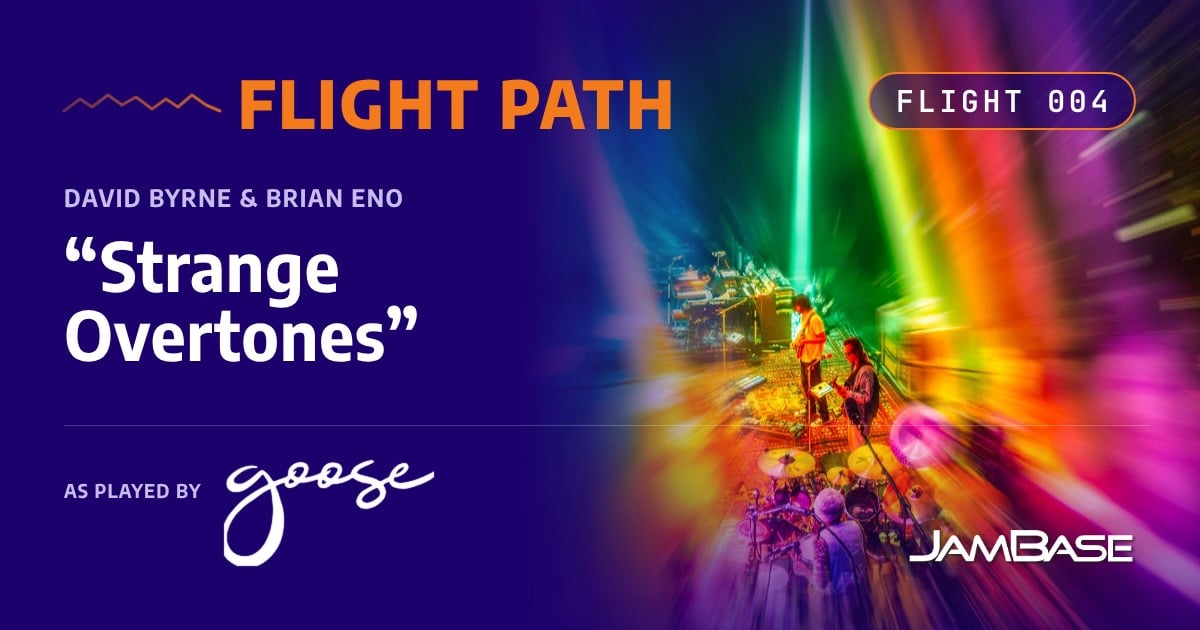
Covers have always been an essential part of the Goose experience. Some are familiar favorites; others come from surprisingly deep in someone else’s catalog.
Flight Path follows those songs beyond the Goose setlist and back to the artists who wrote them and the deeper musical histories behind them.
Debuts, one-offs, fan favorites and standout performances. We’ve got you covered.
“Strange Overtones” begins with David Byrne, the former Talking Heads frontman, imagining a songwriter listening to his neighbor through the wall of the next apartment.
He hears footsteps on the stairs, then singing, and before long he begins critically analyzing the music coming from next door. The groove sounds dated, the beats sound 20 years old and the song still needs a chorus. Yet rather than simply ignoring what he hears, the narrator is drawn into it, eventually offering to harmonize.
As “Strange Overtones” continues, Byrne’s attention shifts from the neighbor’s song to songwriting itself. He’s thinking aloud about beats and melodies, choruses and key changes, and the intangible things that make a piece of music stick.
Seventeen years after its release, Goose gave the song another life. There is a wonderful bit of symmetry in a song that jokes about beats sounding 20 years old finding another audience nearly two decades later. And they still sounded pretty damn good in the 2025 debut.
This groove is out of fashion
These beats are 20 years old
To understand why a 20-year-old beat meant something coming from Byrne requires going back considerably more than 20 years.
Everything That Happens
Brian Eno began working with Talking Heads in 1978, producing their second album, More Songs About Buildings And Food. He returned for Fear Of Music the following year and Remain In Light in 1980, during a period in which the band moved away from conventional rock arrangements and toward repetition, interlocking rhythms, electronics and music assembled in layers. The result was a three-album run that stands among the most groundbreaking and exciting stretches any rock band has ever produced. And merely calling him producer WAY undersells his contributions. His role on Remain In Light, for example, went well beyond conventional production. He was heavily involved in the album’s loop-based construction, layered rhythms, electronics and studio experimentation, and he received songwriting credit on every track.
That final album also produced, of course, another connection to Goose: “Crosseyed And Painless,” one of Remain In Light’s signature songs, would eventually become the band’s most frequently performed Talking Heads cover. They have likewise covered “Psycho Killer” and “Burning Down The House.”
Byrne and Eno went on to make 1981’s deeply experimental My Life In The Bush Of Ghosts. Instead of building songs around a traditional lead singer, they constructed tracks from loops, rhythms and fragments of speech pulled from radio broadcasts, sermons and other recordings. It sounded less like a collection of songs performed by musicians than music being assembled out of pieces randomly collected on a tape recorder.
After My Life In The Bush Of Ghosts, Byrne and Eno went their separate ways, each spending the next two decades pursuing an increasingly wide range of projects. When they eventually found their way back to one another, more than a quarter-century had passed since their last album together, and both arrived with remarkable careers that had grown far beyond the music they had once made together.
Trying to make another Remain In Light would have been pointless. And, of course, impossible. Trying to recreate My Life In The Bush Of Ghosts would have been an equally difficult task.
So they didn’t.
The project that became Everything That Happens Will Happen Today began with Eno sending Byrne a collection of instrumental tracks he had been working on. Byrne spent months listening and living with them, trying to figure out what kinds of songs might be buried inside Eno’s music.
He eventually told Eno that he heard what he described as a kind of “folk-electronic-gospel” music, an unlikely combination of deeply human forms with modern electronic production. The album was built around that contrast. Eno described their goal as combining something human, fallible and personal with something electronic and mathematical.
The process reversed the usual order of songwriting. Eno had already created much of the music, and Byrne had to figure out the melodies and words that could turn those instrumental tracks into songs. Some made that easier than others. Eno initially wondered whether the particularly abstract backing track for “I Feel My Stuff” could become a song at all.
Byrne found one in it.
More Flight Path


Your Song Still Needs A Chorus
That unusual way of working also gave “Strange Overtones” an interesting subject. Byrne had spent months listening to Eno’s unfinished music and figuring out what songs might be hiding inside it. In “Strange Overtones,” his narrator does much the same thing with the music coming through the apartment wall, listening closely as a neighbor works on a song and imagining what it might become.
Your song still needs a chorus
I know you’ll figure it out
An overtone is a frequency above a fundamental tone that contributes to a musical sound’s character. Byrne’s “strange overtones” can also hint at the traces of other songs, people and eras that we hear in music.
Coming from Byrne and Eno in 2008, it was hard not to hear their own history in those words. These were two musicians whose work had helped shape new wave, dance, alternative rock and electronic music, reunited decades later in a musical world that had absorbed many of their ideas.
Byrne seems perfectly comfortable singing about an unfashionable groove and 20-year-old beats. There’s an understanding that music doesn’t lose its value simply because it sounds dated. That same openness runs through the narrator’s relationship with his neighbor: what begins as footsteps and singing through a wall gradually becomes close listening, curiosity and finally collaboration.
Appropriately, “Strange Overtones” became the song that introduced Byrne and Eno’s reunion to the world. They released it as a free download on August 4, 2008, two weeks before Everything That Happens Will Happen Today arrived.
Advertisement
I’ll Harmonize
Goose debuted “Strange Overtones” on December 13, 2025, during the second night of Goosemas XII at Providence’s Amica Mutual Pavilion. The annual event had been transformed that year into Barnaby Glimpse’s Show Upon Time: A Phantom Menagerie, an elaborate dark-carnival production filled with costumes, puppets, performers and a mythology created by Goose.
That year’s Goosemas took place under difficult circumstances.
Earlier that day, a gunman opened fire at Brown University, only a few miles from the arena, killing two students and wounding nine others. The gunman remained at large as thousands of fans streamed into downtown Providence for the sold-out show, while students and residents around Brown were instructed to shelter in place.
Before the concert, Goose issued a statement saying that its “hearts are with everyone in the Brown University community” and announced that Goosemas would proceed as scheduled, with additional police and security in place around the venue.
The contrast was odd: a city dealing with tragedy outside the arena and, inside, a night designed quite literally as a carnival.
The concert opened quietly. Rick Mitarotonda appeared amid candles with members of the Providence College Choir for Goose’s first performance of the traditional “Wild Mountain Thyme,” itself a song with a long history stretching back through generations of folk music. The choir remained for “Give It Time,” after which the show gradually returned to the strange theatrical world Goose had created for Goosemas.
Later in the first set, an unfinished “Into The Myst” gave way to something entirely new.
For the first time, Mitarotonda began singing “Strange Overtones.”
The choice fit comfortably within the strange musical world Goose had constructed for the evening. Byrne and Eno’s original is compact and tightly arranged, and Goose left that largely intact. Cotter Ellis settled into the song’s repetitive beat while Peter Anspach supplied the electronic textures around it, giving Mitarotonda room to make the most obvious change.
He doesn’t sing “Strange Overtones” like David Byrne. Byrne’s delivery is conversational and slightly detached. Mitarotonda leans much harder into the melody, climbing into falsetto and giving the song a different kind of warmth. It proved an exceptionally good fit for his voice.
From there, the arrangement dissolved into a separate three-minute piece appropriately titled “Strange Overtonez,” an ambient extension of electronic textures and sampled dialogue from the Goosemas mythology. Fittingly, it wasn’t far removed from the experimental world of Byrne and Eno.
It also gave the title another meaning. In its first Goose performance, a song about the secondary sounds surrounding a fundamental tone had produced a secondary piece of music of its own.
Later that night, Goose also debuted The Band’s “Life Is A Carnival” and reprised Caravan Palace’s “Dramophone,” which they had unveiled the previous evening.
Watch the full December 13, 2025 Goosemas performance below:
Another Strange Overtone
When “Strange Overtones” returned in St. Augustine on April 18, 2026, the carnival was gone. This time it came out of an alternate arrangement of “Your Direction,” and Goose stretched it to 10 minutes. The song clearly didn’t need Goosemas to work.
More performances followed, including a particularly strong version in Amsterdam on May 27, 2026 that segued directly into “Spirit Of The Dark Horse.” Summer appearances at SPAC, Stanford and Red Rocks further established its occasional place in the repertoire. On November 7 at Milwaukee’s Miller High Life Theatre, another 10-minute rendition flowed into “Earthling Or Alien?” and then “Spirit Of The Dark Horse.”
I see the music in your face
That your words cannot explain
In its first year, “Strange Overtones” has already seemed unusually comfortable in Goose’s hands. Maybe that’s one of those intangible things Byrne was thinking about in the first place. The beat can get old and the groove can fall out of fashion, but some songs simply stick.
Perhaps someday another band will encounter the song through Goose and decide to play it themselves. Someone in that audience might know it simply as an old Goose cover, unaware of Byrne and Eno or everything that came before.
By then, Goose would simply be another part of the song’s history.
Another strange overtone.
Advertisement
Loading tour dates
