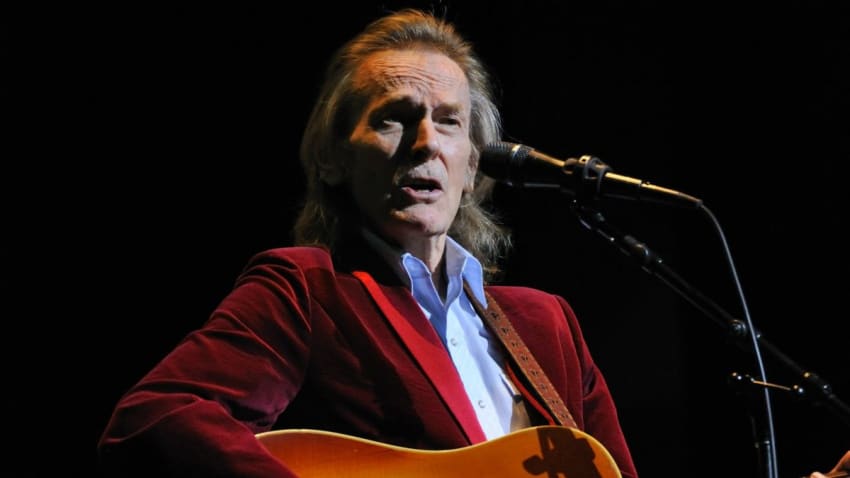
Gordon Lightfoot was born on November 17, 1938 in Orillia, Ontario, Canada. His parents recognized and encouraged his interest in music; his first appearance as Massey Hall in Toronto, now a revered standard in his tour schedule, was just before he turned 13, as the winner of a competition for boys with unchanged voices.
After a background in barbershop quartets, and as a member of a duo, Lightfoot struck out on his own in the early 60s. He had written perhaps 75 songs, when he was caught up in the country music scene and folk revival of the time; Bob Dylan's music and a song by Merle Travis, Dark As A Dungeon, combined with his sensitivity, inventiveness and beautiful voice, resulted in his unique songwriting and singing style. In less than two years, between late '61 and some time in 1963, his sound and his life changed forever.
His music was discovered in 1964, when he was performing on the Toronto folk scene; Ian and Sylvia chose two of his songs, Early Mornin' Rain and For Lovin' Me for their next record and Ian Tyson introduced him to Albert Grossman, their manager and also the manager of Peter, Paul and Mary and Bob Dylan. Peter, Paul and Mary recorded the same two songs as Ian and Sylvia and enjoyed considerable success with them. Marty Robbins recorded Lightfoot's Ribbon Of Darkness, as he says "in Gordon Lightfoot's style", and took it to the top of the Billboard Country charts. Albert Grossman signed Lightfoot and under that arrangement he recorded five albums for United Artists, four studio albums and one live album - to this day, the only live album he has ever released.
At the completion of his contract with United Artists, Lightfoot signed with Warner/Reprise and - from 1970 through 1998 - released 14 more original albums including If You Could Read My Mind, Summer Side Of Life, Don Quixote, Old Dan's Records, Sundown, Cold On The Shoulder, Summertime Dream, Endless Wire, Dream Street Rose, Shadows, Salute, East Of Midnight, Waiting For You, and his latest A Painter Passing Through. The remaining albums, termed the "Final Four" by fans, were released on CD for the first time in the summer of 2002. In addition, he released two "greatest hits" compilations, Gord's Gold and Gord's Gold Volume 2 on which a significant number of tracks were new recordings. He also split with Grossman when he went to Warner Brothers and formed his own company, an arrangement that continues to this day.
Although he toured in the US and in Canada during the 60s, his chart appearances were in Canada only. But following his first LP release with Warner Brothers - an album originally titled Sit Down Young Stranger - a disc jockey with a discerning taste in music began to play one of the tracks from that album on the radio. It was not the title song, but the next track, a song titled If You Could Read My Mind.
That song was Lightfoot's breakthrough on the US charts, reaching #5, and was to become one of the most covered songs in popular music history. It has been recorded by artists across the musical spectrum - country, folk, bluegrass, pop, even disco. In 1998, a new dance version was released, sung by three disco divas: Ultra Naté, Amber and Jocelyn Enriquez.
But the adaptability of his songs, and his own style, is not limited to this one song. Lightfoot himself evolved from a country/folk sound, to folk/rock, pop, and adult contemporary styles. Yet he is always able to move back and forth among the styles, performing his classics from the 60s (like Early Mornin' Rain, Song For A Winter's Night and Canadian Railroad Trilogy), his hits from the 70s (Sundown, Carefree Highway, Wreck Of The Edmund Fitzgerald as well as If You Could Read My Mind), and material from the 80s and 90s with equal ease and credibility.
After some harder edged music in the early 80s, followed by a very contemporary sound on his 1986 East Of Midnight album on which he co-wrote, with his friend David Foster, the very beautiful Anything For Love, he returned to his acoustic roots and recorded two albums in the 90s with a sound more reminiscent of his very early recordings.
From the 60s until today, many top artists have covered his songs, including Elvis Presley, Bob Dylan (and Lightfoot has recorded his songs as well), George Hamilton IV, Olivia Newton-John, Barbra Streisand, Tony Rice, Nanci Griffith and Sarah McLachlan as well as those mentioned above and other talented artists too numerous to list. His achievements have been recognized in the music industry and in his native Canada. He has five Grammy nominations and 17 Juno Awards (the Canadian equivalent) and was inducted into the Canadian Music Hall Of Fame in 1986. In 1970, he received the prestigious Order Of Canada; in 1997 he received the Governor General's award - the highest official Canadian honor; and in September, 2001, he was inducted into the Canadian Country Music Hall Of Fame.
Six of his albums have gone "gold" or higher in the US, the most recent of which was Gord's Gold Volume 2 which was certified gold in September, 2001.
All of this discussion is mostly about the music, always beautiful, inventive, and performed with perfection at every concert appearance - a tribute to his fine backup band as well as to Lightfoot himself. But it is perhaps his lyrics, and the combination of his words and music, that set him apart from all the others. What is unique about Lightfoot is that is that he appears to have heightened senses; he sees, hears and feels things that most of us don't; and then he can create the music and lyrics to help us see, hear and feel what he does. Whether it is a love song, or a song of lost love, a historical ballad - which he writes like no other songwriter of the last half-century - or a highly personal song, what he says and how he says it leaves a lasting and often evolving impression as the listener uncovers new layers of meaning in the song.
In 1999 Rhino Records released Songbook, a four CD boxed set of Lightfoot recordings, and a long overdue tribute to one of the greatest singer/songwriters that ever lived. Read a detailed review and the complete track listing. In April 2002, Rhino released a Complete Greatest Hits album, on one CD or cassette. This album is a wonderful collection of his hits, and brings together the four biggest onto one album for the first time. The remastering and packaging are exquisite as well, as is characteristic for Rhino. Complete Greatest Hits quickly went gold in Canada, and can be expected to eventually go gold in the US.
In April, 2000, Lightfoot taped a live concert in Reno, NV. A one hour show was broadcast by CBC in October, and a PBS special is was aired on many PBS stations across the US. PBS stations offered a videotape of the concert as a pledge gift, and a tape and DVD were released in 2001 and early 2002 in Europe and North America. This is the first Lightfoot concert video ever released.
His legacy is thankfully still being written, as he continues to write and to tour. In a career spanning more than 35 years, he has recorded over 200 songs, and written many more. He has influenced the sound of other highly successful artists who have credited him as a major influence (for example, Dan Fogelberg, Jimmy Buffett, Jim Croce and Ron Sexsmith). If you only know Lightfoot for his hits, then you are missing a lot of the treasures. If you like music, just about any style, you are sure to find a favorite song among the many he has written and recorded.
Bob Dylan calls Lightfoot one of his favorite songwriters. He is certainly my favorite. Perhaps he should be yours?