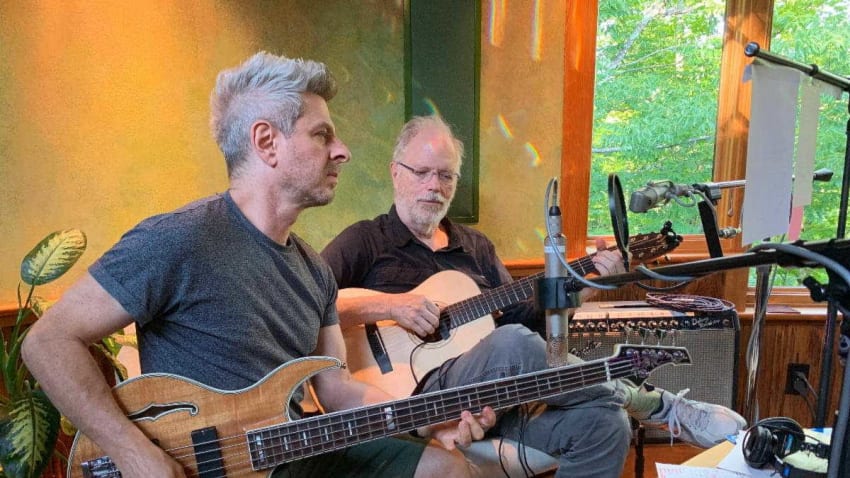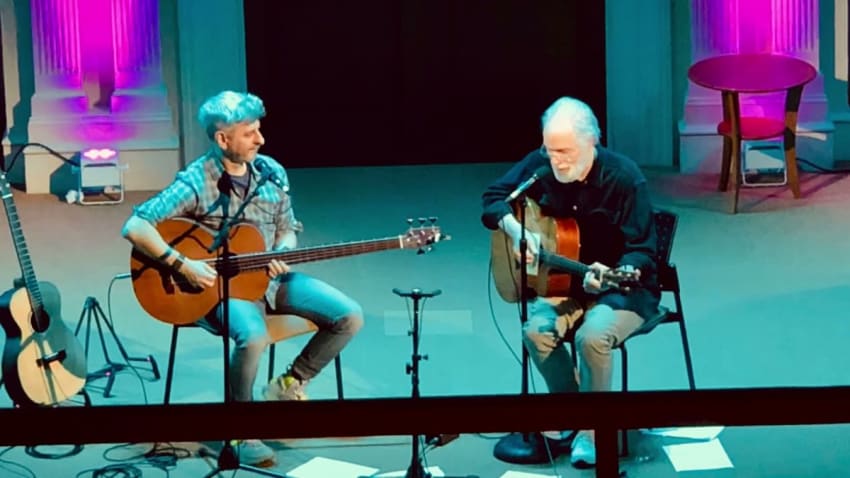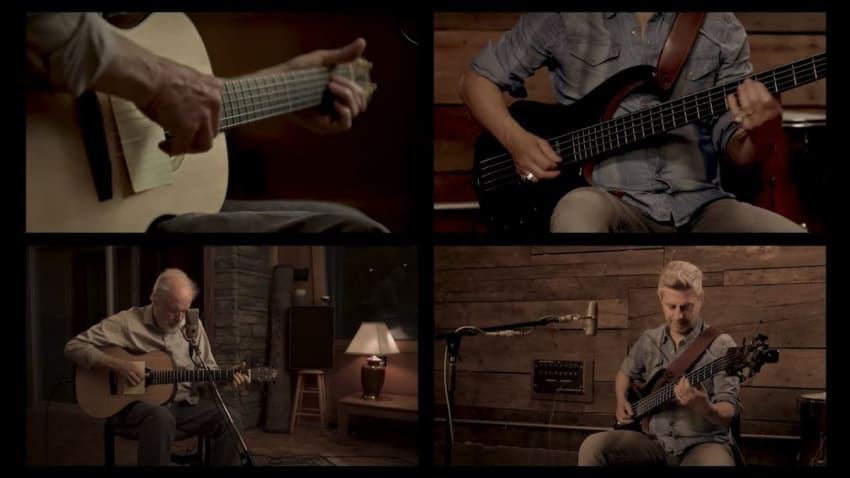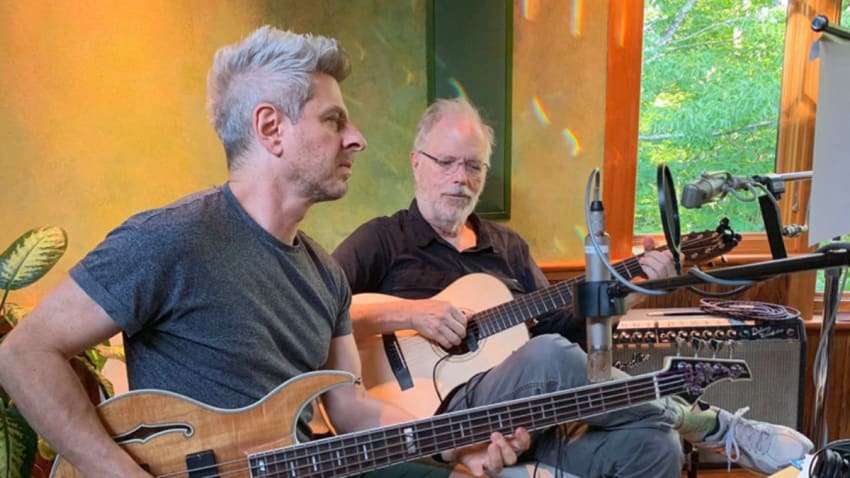
Sixty Six Steps took a couple months to make and most of a lifetime to plan. The
inspiration for the album - the second collaboration between guitarist Leo Kottke
and erstwhile Phish bassist Mike Gordon - dates back to a childhood vacation Gordon's
family made to the Bahamas. The not-quite-teenaged Gordon heard a calypso band
called the Mustangs playing around a pool, and the groove and good feelings generated
by their music stuck with him.
"Ya Mar," one of the songs on a Mustangs album that Gordon got hold
of, eventually became a staple of Phish's live shows. Now "Ya Mar"
is one of fourteen tracks on Sixty Six Steps, which is both an homage to and
an experiment loosely involving island rhythms.
"There are these syncopations within Leo's guitar playing that twist
around in a way that remind me of calypso," explains Gordon. "So this
album took form as an experiment in my mind to see whether Leo's unique
style of playing could be mixed with this kind of music I discovered and really
loved when I was younger. And it worked far beyond my expectations."
"Mike was the first to notice that aspect in my playing, and I think I'd
forgotten it was in there," says Kottke. "No one else had done that.
He's very intuitive that way." The pair had already successfully tested
the waters as collaborators with the album Clone, released in 2002. When they
crossed paths last year at a music festival, Gordon told Kottke that he really
wanted to do a island experiment as his first project following the Phish era.
Already Gordon had done some bass-and-drum jams with Neil Symonette, the renowned
house drummer at Compass Point Studios in Nassau, and then worked up some of
the twenty-plus grooves they'd recorded into songs at his office-studio
in New York. Now Mike was eager to get Kottke involved. Could they get together
to learn and write some songs? Kottke, whose union with Gordon as a collaborator
is distinctive in his otherwise utterly solo career, saw the creative possibilities
in Gordon's vision and said yes. From that point on, the album progressed
quickly.
"It really flowed," Gordon notes. "I presented Leo with the
idea in September, we were making demos and recording tracks in December, and
we were mixing it a month or so after that."
Rehearsed in Costa Rica and recorded in the Bahamas, Sixty Six Steps is seasoned
with the buoyant rhythms and freewheeling spirit of the tropics. It is not literally
a calypso album but one that uses the calypso feel as a touchstone for a set
of performances by two of the most imaginative and mold-breaking musicians on
the planet.
"It's not that the songs are calypso in terms of the obvious, umbrella-drink
sort of calypso," Gordon explains. "They're just a little bit
infused with the island sound."
"Being in Costa Rica and the Bahamas was really important for the project,"
he continues. "I don't think it would've come out like that if
we hadn't had Neil and recorded it in this exotic place."
Sixty Six Steps is a mixture of originals and interpretations performed in
ways that are vaguely familiar yet largely without precedent. For instance,
you'll find a cover of Aerosmith's "Sweet Emotion" sung
in a deadpan monotone and performed on baglama (a Turkish banjo/mandolin-type
instrument), guitar and bass. Then there's a pastoral Pete Seeger composition
("Living in the Country") given a spritz of equatorial light and air.
A twisted Mike Gordon original ("Stolen Quiet") professes mock gratitude
for a partner's exodus from their shared abode: "The sheer amount
of surface space increased around here/With your diet soda gone, there's
more room for my beer." An equally offbeat Leo Kottke original ("Balloon")
features such lines as "When the raccoon steals the cheese behind Pandora's
other box/Or the one you love is shopping for a helmet made of rocks/Balloon,
balloon, balloon…."
Most amazingly, the lyrics generally have some basis in reality, and the music
comes naturally to these idiomatic adventurers. Take the line about the cheese-stealing
raccoon. When Kottke and Gordon made their five-day hiatus to Costa Rica, occupying
a cliffside house with an infinity pool at its edge, they were warned that a
species of Costa Rican raccoon – known as a pizote to the locals –
would think nothing of entering a home and raiding a refrigerator for food.
"We heard the stories, but we didn't believe it," Gordon says,
laughing. "Then we left the door open to the pool area one night. I looked
over behind Leo's chair, and this pizote was leaving the house with a package
of cheese in his hands.
"I loved Costa Rica," adds Kottke. "As soon as we landed, all
this baggage and tension sliding away. The animals and vegetation are so different.
Not just the pizotes, but there were these yellow birds that would land in the
pool and kind of skim across it, and it was obvious they enjoyed doing that….because
they weren't designed for it."
From Costa Rica, they headed straightaway to Nassau, Bahamas, where they hooked
up with producer David Z (Prince, Johnny Lang) and drummer Symonette. Kottke
and Gordon's Clone had been mixed by David Z, and Kottke goes back a ways
with his fellow Minnesotan. According to Kottke, "Z is great with people
like us, and he helped moved the album along."
"One day he was out sick," Kottke recalls with a chuckle, "which
left Mike and I alone in the studio, and he was missed. We worked on one bar
of one song for most of the day. It's like that paradox about shooting
an arrow into a tree. If you bisect the arrow's movement, and then bisect
it again and again, you can divide it in half to infinity and the arrow never
gets there. That's how obsessive Mike and I can get when there's no
one there to push us forward."
As for drummer Symonette, Kottke is lost for words. "I'm stammering….I'm
speechless!" he laughs. "I've never worked with a drummer who
could bend quite like that, and straighten me out at the same time. He's
beautifully sensitive. He's a very inspired and accommodating musician."
"His groove is very deep and his personality is incredible," adds
Gordon. "He brought more than fifty percussion instruments, a lot of which
he made himself, to the sessions. And he kept layering percussion over the tracks."
The trio formed a tight alliance that will exist beyond the sessions for Sixty Six Steps. They're slated to perform ten dates in June at events like the
Telluride Bluegrass Festival and venues like Colorado's beloved Red Rocks
(where they'll share a bill with Gov't Mule and moe.). Then the three
will embark on a full tour in the fall. These dates will mark the first time
that Kottke has toured and performed onstage with a drummer.
Incidentally, the title Sixty Six Steps is taken from a sign at the base of
a staircase leading to what is reputedly the highest point on the island. The
steps curve around and go to the top of the hill, which is a great spot from
which to view the sunset. In its own way, Sixty Six Steps winds and ascends
to a point from which the listener can savor some truly unique musical vistas.