It is said that passion intensifies with restraint; then the beautifully cool
vocals of Susana Baca over her band's deep Afro-Peruvian grooves is as emotional
as it gets. On this collection of classic songs they move their deep traditions
forward by collaborating with the cream of New York's downtown musicians and producers.
A visionary artist.
Susana Baca is wed to a sound and a history. Her music was born in the coastal
barrios of Peru, but her artistry can't be contained within these boundaries,
just as her appeal can't be limited to cognoscenti of Afro-Peruvian traditional
song. Listening to her sing, you hear not simply a Peruvian song, or a Latin
singer, but a singer and a voice capable of moving any listener. Doesn't matter
who you are or where you're from. Doesn't even matter if you understand Spanish.
Listen, and you will go to the place Susana wants to take you, a place of joy
or sadness or longing or resolve.
Eco de Sombras represents the further emergence of Susana Baca from the rich
Afro-Peruvian musical tradition first introduced to North American listeners
on The Soul of Black Peru, and her self-titled Luaka Bop debut. Here, alongside
the cajon are the modern sensibilities of such guest musicians as John Medeski
and Tom Waits veterans Marc Ribot on guitar and Greg Cohen on bass. On "Valentin,"
or "Xanajari," you can hear the sometimes eerie, sometimes playful
sounds you might expect from Waits, building on atmosphere created by Baca and
her incredible Peruvian band.
Not that Susana Baca has left behind the souls or songs or sounds of her enslaved
ancestors. Still to be heard in her songs are the stories of slave life and
the struggles of Peruvian peasants. This is the culture she has sought to preserve
and document in previous recordings. This is the sound, varied and powerful,
first brought north on The Soul of Black Peru. No Latin music is more vital,
none less predictable than Afro-Peruvian music.
In 1992, in Lima, with her husband Ricardo Pereira, Susana founded the Instituto
Negro Continuo to teach and preserve the dance and music of her ancestors, but
also to encourage young Peruvian artists to find their voices and to make the
art of their own generation. Know the history, honor it, but go from there.
Move forward. On Eco de Sombras, Susana Baca practices what she preaches. These
new songs, her best ever, represent a mix of the old and new made one, and made
current by her voice, her artistry, and by the chances she has taken.
Susana and her band mates of five years spent a fall and winter south of the
Equator, meeting nights at her airy house on the coast outside of Lima to sing,
play music, to eat what Susana cooked up for them, to laugh and play some more,
seeking the perfection of the recording studio and the spontaneity of a homegrown
jam session. Listening to this sometimes lively, sometimes quiet recording,
you'll find yourself drawn in, transported to that house full of spirits.
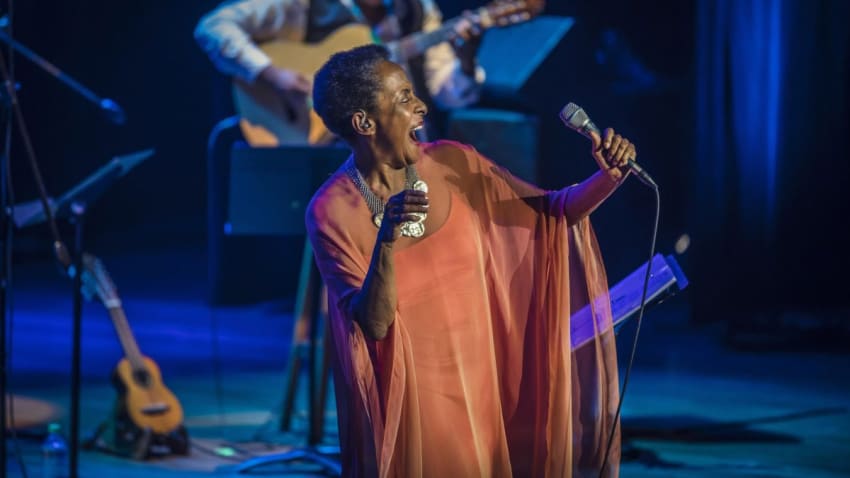
It's recording time, probably late into the night, Susana stands alone, a silhouette
in a narrow, dark hallway just outside the bedroom, just the singer and the
microphone and the words to her songs, her musicians scattered throughout the
house. She shifts anxiously from one bare foot to the other, giggles nervously
at the jokes and laughter percussionists Hugo Bravo and Juan Medrano Cotito
constantly inspire in their fellow band members. She is poised to sing. Momentarily
the purity of her voice will fill the house; that voice, intertwined with the
intricate, passionate guitar of Raphael Muñoz. David Pinto's bass will
lead the band from measure to measure to coda, then a brief silence, then more
laughter and talk until the next song begins or the last one must be sung and
played again. Sometimes the decision to rerecord comes from Susana, sometimes
from the perfectionist Pinto, sometimes from Ricardo Periera, whose ear and
care for the songs is keen. But often the decision is made by producer Craig
Street, whose easy confidence in the music and the musicians has turned any
problems presented by home recording into adventures and triumphs.
Street has done a masterful job -- what he knows best is that what matters
when it's all sung and played is the voice. Even with his limited Spanish, Street
knows exactly what Susana Baca is trying to say and to feel, where she is trying
to take us and if she has succeeded. As he has done with Cassandra Wilson, with
Meshell Ndegeocello, with Paula Cole, and others, he has believed along with
Susana Baca that the voice is the song, that everyone who hears it will know
this as well. That on a winter night in Lima or a summer day in Berkeley or
New York or Kenosha, Wisconsin, nothing is really complete until Susana, singing
in her dark and narrow hallway, has shown you the way.